

Today Venice expands Tailored Access with the Venice Identity Gateway - detecting agent intent and ownership, authorizing every action at runtime, auditing all of it in full. Just-in-time privilege that fits the task, now for AI agents as well.
AI agents are arriving in production faster than anyone planned for, and every one of them needs access to do its work. The business wants to say yes to that, and so do we - the job isn't to slow agents down, it's to put the right guardrails in place so it's safe to grant them access. The more we looked at it as a team, the more an agent looked like just another identity, raising the same challenges we already had with people.
Human privileged access piles up quietly, and not because anyone is careless: when access is slow to get, what people actually do is to ask for as much as they can for as long as they can, so entitlements stockpile far faster than anyone can keep up with. Just-in-time access is the model Venice has built from day one for the people and service accounts doing the work: privilege appears the instant work calls for it and disappears the moment the task is done.
An agent takes that same habit and makes it dangerous, acting on all of its access at machine speed without the judgment to stop when something looks off. The tooling most enterprises would reach for makes that worse: a vault hands over the identity's full standing access, then looks away - survivable for a person a few times a day, broken for an agent making thousands of calls with it. So we took the just-in-time model Venice already runs for people and extended it to the agents working alongside them, authorized by intent, at runtime.
With the Venice Identity Gateway, Tailored Access now combines:
- Intent and ownership detection
- Contextualized controls and runtime authorization
- Advanced credential management
- Just-in-time access
- Full, detailed audit for every access
Agents, NHIs, and humans: each gets its own suit, on a single platform. No standing access.
Agents Enter the Same Identity Model as Everyone Else
An agent shows up in Venice as a first-class identity, listed beside humans and service accounts, on the same identity page as the person it answers to, scored by the same risk engine and written to the same audit trail. Venice connects to the platforms where agents actually run and discovers them along with their owners, so an agent enters the model as a peer to every other identity rather than something tracked off in its own console.
Discovery isn't there to catalog every agent, it's there to bring one on board so its access can be enforced. Because Venice already holds the privileges around the identity the agent answers to, onboarding maps the agent's job to a scoped slice of that access: what the task needs, and nothing broader.
Scope the Access, Stop It When It Oversteps
Putting an agent into use in an organization safely comes down to the same questions you'd answer for any privileged person:
- Can it do only what its task needs, and nothing broader?
- If it steps outside that task, is it stopped before the call completes, or do you find out from a log the next morning?
- What did it actually touch: which tools, which parameters, which data?
- Does it ever hold a credential that could be leaked or stolen?
- Which human, and which task, is the call accountable to?
Venice answers these where it already answers them for people: in the access gateway between an identity and the system it's reaching for. For an agent, that gateway now uses MCP, the protocol agents use to call tools. To the agent Venice looks like just another MCP server; in practice it's the single control point in front of every system the agent can touch.
What sets that control point apart is what it does when a call is allowed. Most gateways stop at a verdict, permit or block; Venice provisions the access, elevating the specific short-lived access the task needs on the target system itself and rolling it back the moment the work is done. The agent never holds a credential of its own, so there's nothing in its context to leak or steal.
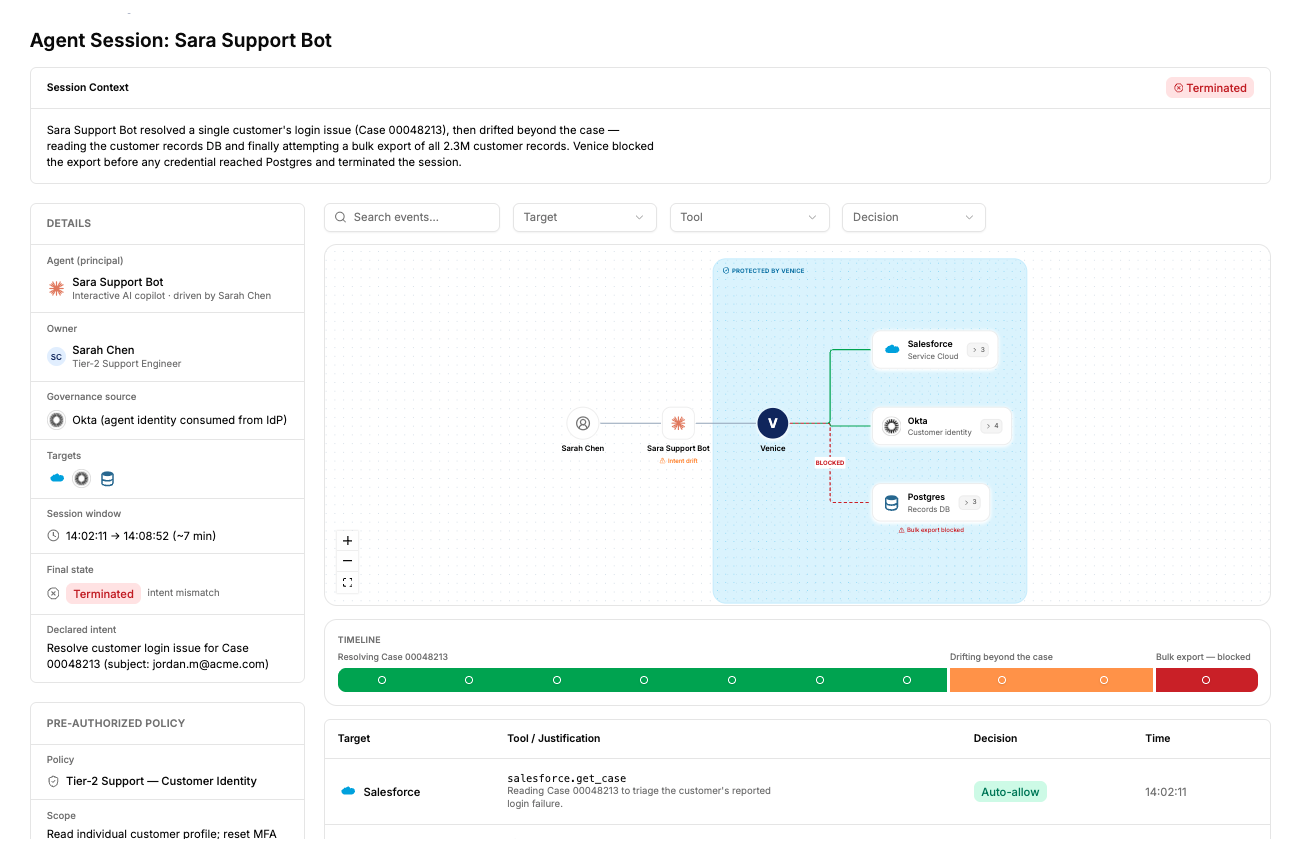
Every call is then measured against the task the agent declared when the session opened, not re-approved one prompt at a time, and weighed against the session's running history, the human the agent is bound to, and risk signals like an unusual volume or a step up in sensitivity. A call that fits proceeds; one that drifts is stepped up for approval, or the session is ended in the act and its access revoked on the spot, before the call completes rather than after it surfaces in a log.
Full Context, All the Way to the Human Owner
What decides whether you trust an agent in production isn't only what it did, it's whether what it did matched its task and who it ultimately answers to. Because an agent resolves through the chain to a real human owner, Venice follows any action all the way back to the person and the task it's accountable to, however many agents sit in between. The record reads as the full context of the work, not a flat list of API calls.
And it's the same session analysis Venice runs for people, not a session recording left for someone to watch later. The automated analysis that flags where a human stepped outside their task applies to the agent: where it stayed in bounds, the exact point any call drifted, and the access that was elevated and rolled back. An auditor can confirm whether an agent ever exceeded its task without taking anyone's word for it, and an engineer can trace a bad outcome to the precise call that caused it and the human who owns it.
See It Live at Identiverse
The Venice Identity Gateway is the same just-in-time privileged access we've always run for humans and service accounts - now extended to the agents working alongside them. One identity model, one gateway, one audit trail
We're showing the whole arc live at Identiverse: an agent requests access for a real task, Venice elevates it just-in-time on the target system, the agent drifts into work it was never asked to do, and Venice ends the session in the act, then shows exactly what happened and why. Come see an agent get governed the same way your people already are.
Frequently asked questions
Related articles




Privacy Preference Center
When you visit any website, it may store or retrieve information on your browser, mostly in the form of cookies. This information might be about you, your preferences or your device and is mostly used to make the site work as you expect it to. The information does not usually directly identify you, but it can give you a more personalized web experience. Because we respect your right to privacy, you can choose not to allow some types of cookies. Click on the different category headings to find out more and change our default settings. However, blocking some types of cookies may impact your experience of the site and the services we are able to offer. Learn more about cookie consent
Manage Consent Preferences
These cookies are essential for the website to function properly and cannot be disabled.
These cookies enable enhanced functionality and personalization, such as videos and live chat.
These cookies help us understand how visitors interact with our website by collecting anonymous information.
These cookies are used to track the effectiveness of our marketing campaigns.
We value your privacy
We use cookies to enhance your browsing experience, serve personalised ads or content, and analyse our traffic. By clicking "Accept All", you consent to our use of cookies.
