



What Are Just-in-Time (JIT) Access Tools and How Do They Work Across Cloud and On-Premises Environments?
Just-in-Time (JIT) access tools replace standing admin rights with temporary, time-bound, and approval-driven permissions across cloud and on-premises systems. Instead of maintaining permanent privileged permissions, JIT tools provision access on demand and automatically revoke it when the approved time window expires or the task is completed. This approach reduces standing privileges and limits opportunities for attackers to exploit compromised identities.
JIT access tools typically integrate with identity providers, privileged access management (PAM) platforms, cloud infrastructure, and enterprise applications to enforce time-bound access policies. Depending on the implementation, they can temporarily elevate existing permissions, provision short-lived credentials, or establish controlled access sessions without exposing persistent administrative credentials. Modern solutions also support automated approval workflows, contextual risk evaluation, session monitoring, and centralized audit trails.
Managing privileged access across hybrid environments requires more than protecting credentials. Just-in-time (JIT) access helps organizations replace standing permissions with temporary, task-specific authorization, strengthening security while supporting efficient access for employees, automated workloads, and AI agents:
- Persistent privileges increase the attack surface: Permanent permissions give attackers and malicious insiders ongoing opportunities to misuse access. JIT limits elevated permissions to approved tasks and time windows, reducing exposure and enforcing least privilege.
- Fragmented controls complicate hybrid access management: Separate cloud IAM systems, Active Directory environments, and local accounts create inconsistent policies and audit trails. JIT platforms can integrate these systems to standardize approvals, authorization, expiration, and visibility.
- Manual approvals and credential vaults slow operations: Ticket queues and credential checkout can delay troubleshooting without eliminating standing privileges. JIT automates low-risk approvals, retains human review for sensitive requests, and can provide short-lived credentials or credentialless access.
- Non-human identities and AI agents need temporary authorization: Service accounts, pipelines, workloads, and agents often rely on long-lived credentials. JIT can provide short-lived, task-specific access, while runtime controls can constrain agent actions by identity, ownership, authorized purpose, and target resource.
In this article
- Just-in-Time Access Tools at a Glance
- Just-in-Time Access for Different IT Environments
- Key Capabilities to Look for in Just-in-Time Access Tools When Supporting Multiple Environments
- Notable Just-in-Time Access Tools for Cloud and On-Premises Infrastructure
Just-in-Time Access Tools at a Glance
The table below summarizes the key differences between the JIT access tools covered in this article. We explore each one in more detail in the sections that follow.
Just-in-Time Access for Different IT Environments
Cloud Infrastructure: AWS, Azure, and Google Cloud
Cloud infrastructure introduces complex privileged access requirements because administrators, developers, and automated workloads frequently need temporary access to cloud resources. AWS, Microsoft Azure, and Google Cloud each provide native identity and access management capabilities, but their permission models, role assignment mechanisms, and approaches to temporary privilege elevation differ. Without centralized governance, organizations may accumulate excessive IAM permissions and permanent administrative roles across cloud accounts, subscriptions, and projects.
JIT access tools integrate with cloud IAM services to grant temporary permissions based on approved requests, identity attributes, and contextual policies. For example:
- AWS: Temporary access can be implemented using AWS Security Token Service (STS), IAM role assumption, and IAM Identity Center integrations. JIT platforms can broker role-based access to AWS accounts and resources while applying approval policies and limiting session duration.
- Microsoft Azure: Microsoft Entra Privileged Identity Management (PIM) supports time-bound activation of eligible privileged roles. JIT solutions can also integrate with Azure role-based access control (RBAC) to manage temporary permissions for subscriptions, resource groups, and individual resources.
- Google Cloud: JIT access can leverage Google Cloud IAM, Privileged Access Manager, and time-bound entitlement mechanisms to provide temporary access to projects and resources. Organizations can define approval requirements, permission scopes, and access durations according to operational needs.
Across these platforms, modern JIT tools help standardize privileged access workflows and reduce reliance on permanent IAM assignments. Advanced solutions can also support short-lived credentials for automated workloads, centralized audit logging, and contextual authorization that considers the requested operation rather than relying exclusively on the user's assigned role.
On-Premises Windows and Linux Servers
On-premises environments often rely on persistent privileged accounts, local administrator permissions, Active Directory groups, and SSH credentials to manage critical systems. These mechanisms can create significant security risks when administrators retain permanent elevated access or when credentials are shared across multiple servers. Implementing JIT access helps organizations reduce standing privileges while preserving access for maintenance, troubleshooting, and emergency operations.
JIT access tools can use different enforcement mechanisms depending on the operating system and infrastructure configuration:
- Windows servers: JIT access may integrate with Active Directory, Microsoft Entra ID, and Windows access control mechanisms to provide temporary membership in privileged security groups or controlled access to administrative sessions. Permissions can be automatically removed after the approved access window.
- Linux servers: JIT solutions can provide temporary SSH access, issue short-lived SSH certificates, or enforce time-limited privilege elevation through mechanisms such as sudo. These approaches reduce dependence on permanent root access and long-lived SSH keys.
- Databases and infrastructure services: JIT platforms may broker temporary access to database administration interfaces, virtualization platforms, and network management systems through native integrations, temporary credentials, or controlled privileged sessions.
Effective on-premises JIT implementations should also support centralized identity verification, session recording where appropriate, and detailed audit logs. Organizations must ensure that temporary privileges are actually revoked when access expires, including terminating or restricting active sessions when required by security policy.
Hybrid and Multi-Cloud Environments
Hybrid and multi-cloud environments combine resources across multiple cloud providers, private clouds, and on-premises data centers. Each environment may use different identity providers, authorization models, credential formats, and privileged access workflows. This fragmentation makes it difficult to consistently enforce least privilege, track privileged activity, and verify that temporary permissions have been revoked across all systems.
JIT access platforms designed for hybrid environments provide a centralized policy and approval layer while integrating with the native enforcement mechanisms of individual systems. For example, an administrator might request temporary access to an AWS production account, an Azure-hosted database, and an on-premises Linux server through a unified workflow. The platform can evaluate each request against resource-specific policies, provision the necessary access, and revoke permissions when the authorized period ends.
Key capabilities for hybrid and multi-cloud JIT access include:
- Centralized policy management: Define consistent access requirements across cloud accounts, on-premises servers, databases, and infrastructure services while accommodating platform-specific permissions.
- Identity federation: Integrate with enterprise identity providers using protocols such as SAML and OpenID Connect (OIDC) to authenticate users without maintaining separate identities for every environment.
- Context-aware authorization: Evaluate access requests based on identity, device posture, requested resource, task purpose, risk level, and other relevant conditions.
- Automated provisioning and revocation: Grant temporary access through supported native IAM mechanisms and automatically remove permissions or credentials when access expires.
- Unified visibility and auditing: Consolidate access requests, approvals, privileged sessions, and authorization decisions into centralized logs for monitoring, investigations, and compliance reporting.
Organizations should prioritize solutions that support both human and non-human identities, particularly as CI/CD pipelines, service accounts, and AI agents increasingly operate across infrastructure boundaries. Applying JIT controls consistently across these identities helps reduce standing privileges and supports a transition toward zero standing privileges without requiring organizations to replace their existing infrastructure or identity systems.
Related content: Read our guide to agentic AI security
Key Capabilities to Look for in Just-in-Time Access Tools When Supporting Multiple Environments
Unified Privileged Access Management Across Cloud and On-Premises Systems
JIT access tools should provide a centralized management layer for privileged access across cloud infrastructure, on-premises servers, databases, and enterprise applications. Rather than requiring administrators to navigate separate access workflows for AWS, Azure, Google Cloud, Windows, and Linux, a unified platform should enable consistent access requests, approval policies, and auditing across supported environments.
Look for solutions that integrate with existing identity providers, cloud IAM services, directory systems, and infrastructure management tools. The platform should support granular permissions for individual resources and operations rather than relying exclusively on broad administrative roles. Centralized governance also helps security teams identify inconsistent access policies and enforce least privilege across hybrid environments.
Continuous Discovery of Privileged Identities and Standing Permissions
Organizations cannot effectively eliminate standing privileges without understanding which identities have access to critical infrastructure. JIT access platforms should continuously discover human and non-human identities, privileged accounts, service accounts, IAM roles, and existing permission assignments across connected systems. This visibility helps security teams identify excessive permissions, unused entitlements, orphaned accounts, and privileged access paths that might otherwise remain undetected.
Advanced solutions also analyze permission usage to distinguish necessary access from privileges that are rarely or never exercised. By mapping identities to resources and actual access patterns, organizations can prioritize remediation and establish appropriate JIT policies. Continuous discovery ensures that newly created accounts, infrastructure resources, and permission changes are incorporated into access governance processes.
Zero Standing Privileges and Automatic Access Revocation
A core capability of modern JIT access tools is supporting zero standing privileges (ZSP), where users and workloads do not retain permanent privileged permissions between authorized tasks. Instead, the platform grants narrowly scoped access when required and automatically revokes it when the task is completed, the approved duration expires, or authorization conditions change.
Look for solutions that can provision temporary permissions through native IAM integrations, time-bound role assignments, and ephemeral access sessions. Effective revocation should remove elevated permissions and invalidate temporary credentials where supported, rather than simply marking an access request as closed. Organizations should also evaluate how platforms handle active sessions, emergency access, and provisioning failures to ensure that temporary privileges do not unintentionally become persistent.
Context-Aware, Risk-Based Access Policies
JIT access decisions should consider more than whether an identity belongs to an approved group or holds a particular role. Context-aware authorization evaluates each request against relevant attributes, such as the requesting identity, target resource, requested permissions, operational purpose, device security posture, and current risk indicators. This allows organizations to enforce more granular access policies that reflect the sensitivity of the requested operation.
For example, a developer requesting read-only access to a staging database may qualify for automatic approval, while a request to modify production infrastructure could trigger additional verification or human review. Advanced platforms can also apply task-aware authorization to AI agents, restricting actions that fall outside the assigned objective even when the agent possesses technically valid credentials. Policy decisions should be consistently enforced and logged, with unauthorized requests denied by default.
Automated Approvals for Low-Risk Requests and Human Review for High-Risk Access
Traditional privileged access workflows often depend on manual tickets and approval chains, which can delay routine maintenance and incident response. Modern JIT tools should automate authorization for requests that satisfy predefined security policies while requiring explicit approval for sensitive or unusual operations. This risk-based approach reduces administrative overhead without removing human oversight where it matters.
Look for configurable approval workflows that consider the requesting identity, resource sensitivity, requested privilege level, and task context. Low-risk requests can be approved automatically, while high-risk access may require authorization from a manager, resource owner, or security administrator. The platform should support time-limited approvals, escalation workflows, and complete records of who approved each request. For AI agents, human-in-the-loop controls are particularly important when autonomous operations involve production changes, sensitive data, or potentially irreversible actions.
Related content: Read our article about AI agent security best practices
Lightweight Deployment and Rapid Infrastructure Onboarding
Deploying JIT access controls across large infrastructure environments can become operationally expensive when implementation requires extensive configuration, additional software components, or significant changes to existing systems. Lightweight JIT solutions reduce deployment complexity by integrating with existing cloud APIs, IAM systems, directory services, and infrastructure access protocols while minimizing infrastructure changes and ongoing maintenance. This approach can simplify onboarding and help organizations extend temporary access controls across cloud and on-premises environments.
Organizations should evaluate whether a platform can discover resources, establish access policies, and begin enforcing temporary privileges with minimal setup and administrative overhead. Support for infrastructure-as-code, API-driven configuration, and automated resource onboarding can further accelerate adoption across dynamic cloud environments. However, lightweight deployment should not come at the expense of security or enforcement coverage; organizations should verify which capabilities require additional connectors, proxies, or endpoint components and assess their impact on operational complexity.
Short-Lived Credentials and Credential Isolation
Long-lived passwords, SSH keys, API tokens, and service account secrets create persistent security risks because compromised credentials may remain usable until they are manually rotated or revoked. Modern JIT access tools should minimize dependence on these credentials by issuing short-lived authentication artifacts or brokering access through controlled sessions. Credentials should have narrowly scoped permissions and expire automatically after their authorized lifetime.
Look for support for temporary cloud credentials, short-lived SSH certificates, workload identity federation, and integrations with existing secrets management platforms. Credential isolation is especially important for non-human identities and AI agents, which may access multiple enterprise systems through automated workflows. Where supported, credentials should be bound to a specific identity, resource, and access context rather than shared across workloads or exposed directly to agents.
Organizations should also assess how credentials are stored, issued, rotated, and revoked, including whether sensitive secrets are exposed to end users or automated processes. Combining short-lived credentials with real-time authorization and centralized auditing helps reduce credential theft risks while maintaining control over privileged infrastructure access.
Notable Just-in-Time Access Tools for Cloud and On-Premises Infrastructure
How we selected these tools: We shortlisted just-in-time access tools based on their ability to grant time-bound, approval-driven privileged access across cloud and on-premises systems, automatically revoke that access, support human and non-human identities, and provide centralized policy management and auditing.
Modern Zero Standing Privilege and JIT Access Platforms
1. Venice

Best for: Lightweight JIT and ZSP across cloud, on-prem, and SaaS systems
Strengths: Context-aware approvals and one-click JIT onboarding
Things to consider: No public pricing, only custom quotes
Venice is a privileged access management platform that grants just-in-time access to human, machine, and AI agent identities across cloud, on-premises, and hybrid environments. It works without agents or redundant vaults: access is granted at the moment of the request, scoped to the task, and removed when the task ends.
Requests are evaluated against a live policy built from identity, environment, task, and risk, so routine access can be approved automatically while riskier requests go to a human reviewer. Venice also discovers standing privileges across the estate, converts legacy vault and shared-account access into JIT policies, and links every session to an identity and an approval decision.
Key features include:
- Estate-wide privilege discovery: Discovers and measures standing privileges for every identity from day one, and keeps them in a single source of truth. A ZSP dashboard shows standing access, risk, and progress toward zero standing privilege with KPIs and AI-generated guidance.
- Unified access requests: Users request, approve, and enter cloud, on-premises, and SaaS systems from one browser tab. Privilege elevation for any machine, whether on cloud or on-prem, runs through the same workflow without tickets, vaults, or side channels.
- Context-aware, policy-driven approvals: Policies are defined once, and Venice decides whether each request is approved automatically, routed for manual review, or blocked, based on identity, task, environment, and risk profile. Requests above a risk threshold reach reviewers with the full context already assembled.
- One-click JIT onboarding: Servers, databases, and cloud resources can be added in minutes without agents. Once a resource is onboarded, its static privileges convert to dynamic, policy-driven access.
- AI-assisted migration from legacy PAM: Venice analyzes existing vaults, shared accounts, and standing permissions, then converts them into JIT access policies. Shared accounts can be kept and rotated where they are still needed, so teams can move to JIT in stages.
- Session accountability and audit: Every request is traced to a decision, every decision to an action, and every action to a monitored session tied to a real identity. The Audit Center collects requests, decisions, and recorded sessions in one place for audit sign-off.
- Access management for AI agents: Sits between AI agents and the resources they call, and checks each call against the agent’s declared task. Agents do not receive credentials, and humans, NHIs, and agents share one risk engine and one audit trail.
Limitations (based on publicly available sources):
- No published pricing: Pricing is not listed publicly, and evaluations start with a demo request.
2. Britive

Best for: Runtime JIT permissions across multi-cloud and hybrid environments
Strengths: Native enforcement at the resource with no proxy in the data path
Things to consider: SaaS-only delivery; on-prem targets require a connector
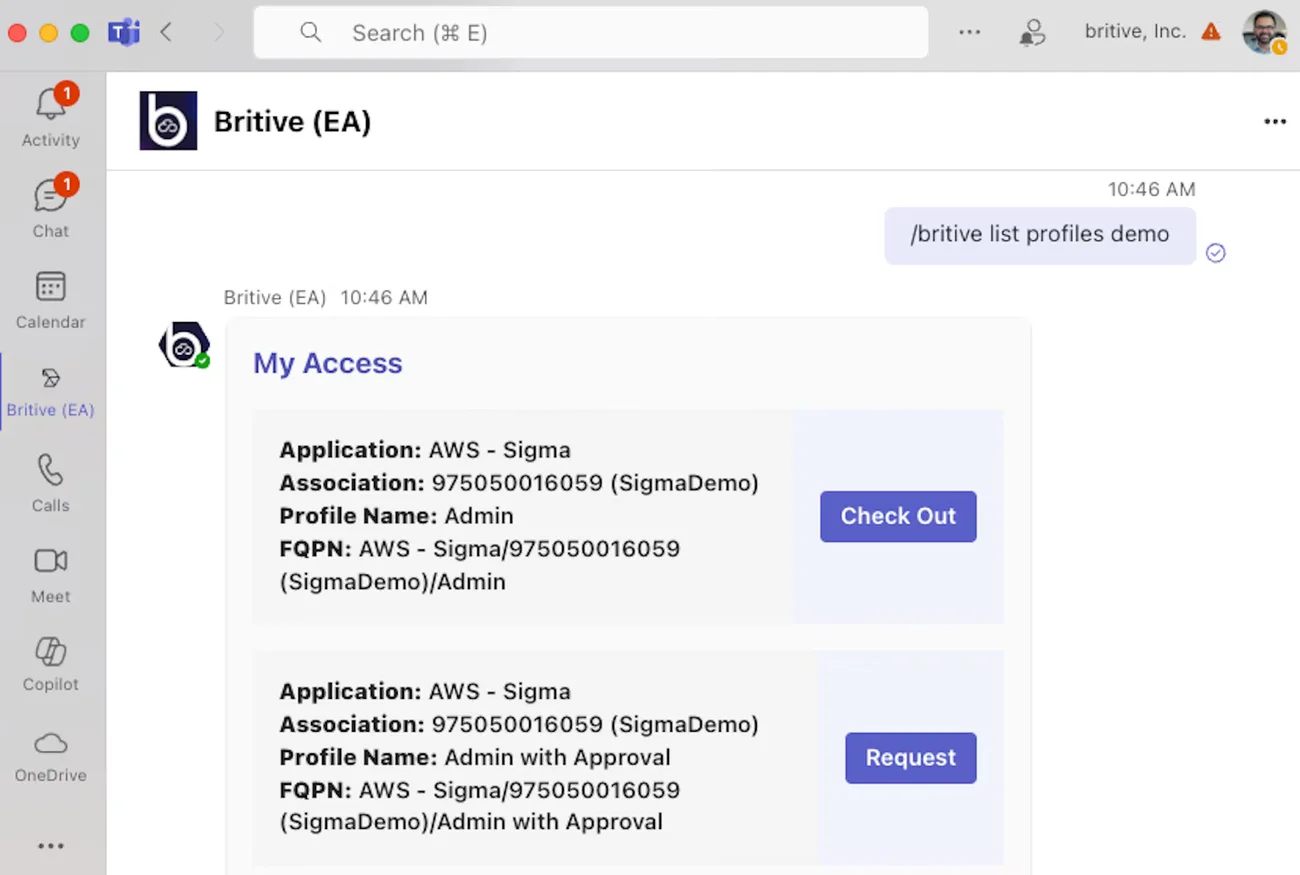
Britive is a cloud-native privileged access platform that authorizes and enforces task-scoped access at runtime for humans, non-human identities, and AI agents. Privileges are created when an access request is approved and removed when the task ends, across AWS, Azure, Google Cloud, and Oracle Cloud Infrastructure.
The platform maps identities and the privileges they can reach, evaluates each request against identity, device, and task context, and provisions access natively at the target resource. It also covers Kubernetes, SaaS applications, databases, servers, and on-premises infrastructure through a proxyless connector, and records every grant, scope, and expiry.
Key features include:
- JIT access across multiple clouds: Creates privileged access at the moment it is needed and removes it automatically when the task ends in AWS, Azure, GCP, and OCI. Access decisions are made at checkout, without pre-provisioned roles.
- Policy-based runtime authorization: Each request is assessed against policy using the identity, device, task, and other context, and authorized only for what the task requires. Authorization is re-evaluated continuously as conditions change.
- Ephemeral access for non-human identities: Service accounts, workloads, pipelines, and CI/CD jobs receive access when a job runs, inside the CLI and tools teams already use. This removes keys stored in code and tokens that outlive the job.
- Native enforcement without a proxy: Authorization decisions are applied directly at the resource rather than through a proxy in the data path. Coverage includes Kubernetes, SaaS applications, databases, servers, and on-prem systems through a private cloud and on-prem connector.
- Identity and privilege discovery: Maps human, agentic AI, and non-human identities and the privileges each can reach across cloud, SaaS, DaaS, on-prem, and AI workflows. Account discovery and drift detection support ongoing governance.
- Britive ARC for AI agents: Registers each agent as an identity with a human owner, evaluates every agent action at runtime, and extends control into sessions and individual commands. An MCP gateway enforces policy on agent tool access.
- Audit evidence and session monitoring: Records every decision, grant, scope, and expiry as access happens, with privileged session monitoring and recording for compliance reporting.
Limitations (based on publicly available sources):
- SaaS-only delivery: The platform is delivered as SaaS, which may not suit organizations that require a fully self-hosted PAM deployment.
- Connector required for on-prem and private cloud: Access to on-premises servers, data centers, and private cloud resources depends on deploying Britive’s private cloud and on-prem connector.
- Pricing by custom quote: Pricing is not published and requires a quote, which makes early cost comparisons harder.
- Few public user reviews: Major review platforms list few or no user reviews, so independent feedback on day-to-day operation is limited.
Source: Britive
3. Apono

Best for: JIT access to cloud roles, databases, and Kubernetes
Strengths: Generates scoped permissions at request time in native policy language
Things to consider: Some integrations and advanced workflows take extra setup
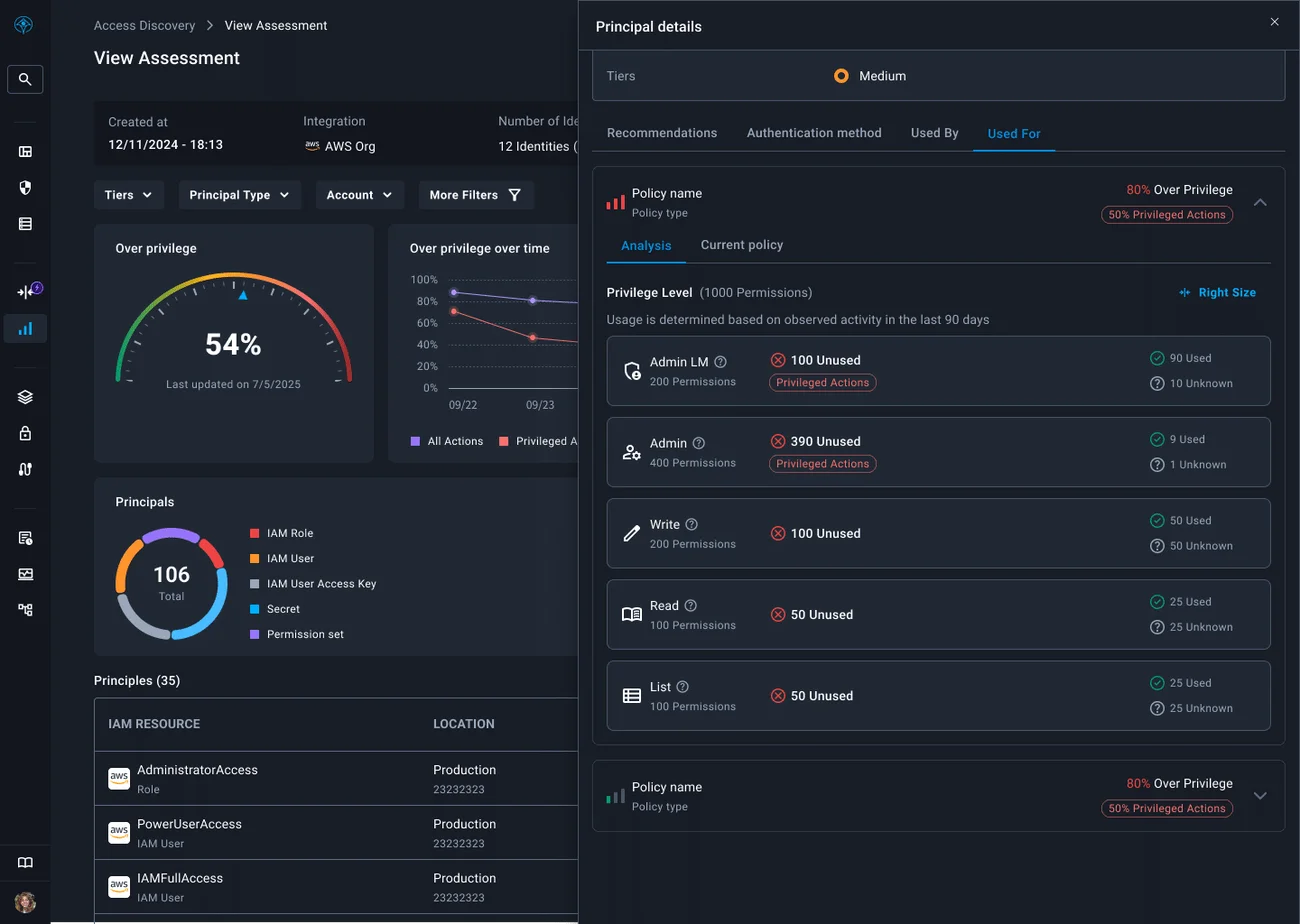
Apono, now part of 1Password, is a cloud-native privileged access management platform that grants just-in-time access to humans, machines, and AI agents and revokes it automatically. Engineers request access through Slack, Teams, Jira, or the CLI, and Apono applies guardrails based on who is asking, what they need, the environment, and the risk.
Instead of maintaining a library of predefined roles, Apono creates IAM roles, permissions, and access policies at request time in the native policy language of AWS, Azure, Google Cloud, Kubernetes, and supported databases. The platform is split into modules for on-prem and hybrid infrastructure, cloud privileged access, and AI agent privileges, which share one policy engine and audit trail.
Key features include:
- Runtime privilege orchestration: Creates IAM roles, permissions, and access policies on the fly, scoped to the exact request, in the native policy language of each cloud platform, Kubernetes, and databases. No pre-provisioned role library is required.
- Dynamic guardrails: Each access decision considers the requester, the requested action, the target environment, and the risk of that action. Policies adjust as the environment changes without manual rewrites of static rules.
- Infrastructure Guard for on-prem and hybrid: Secures privileged access to on-prem and hybrid databases, Kubernetes, and compute resources using account vaulting, MFA-enforced access requests, and dynamic guardrails. Sessions are passwordless, logged, and auditable.
- Requests in existing tools: Engineers request and receive JIT access through Slack, Microsoft Teams, Jira, the CLI, service workflows, or Apono Assist. Break-glass flows support urgent access.
- Agent Privilege Guard: Applies JIT access to AI agents with Intent-Based Access Control (IBAC), where each agent declares its intent before acting and Apono validates that intent against its actual runtime actions.
- Unified audit and anomaly detection: Logs every request, approval, grant, and revocation with business context, generates AI session summaries, and flags behavior that drifts from normal patterns.
- Broad integrations: Connects to more than 85 platforms, including AWS, Azure, Google Cloud, Okta, Entra ID, MongoDB, Snowflake, Databricks, GitHub, GitLab, and PagerDuty.
Limitations (as reported by users on G2):
- Learning curve for advanced setups: Implementation needs careful planning, and some advanced workflows and configurations can be tricky to set up.
- Integration effort: Some integrations still require significant work and research to configure.
- Gaps in application coverage: Users note missing integrations for some tools in their stack, such as incident management platforms, with coverage being added over time.
- Interface navigation: Some screens are hard to reach and lack direct menu links or back and cancel options.
Source: Apono
4. Teleport

Best for: Engineering teams accessing servers, Kubernetes, and databases
Strengths: Short-lived certificates, dual authorization, and session moderation
Things to consider: Self-hosted setup and documentation can be demanding
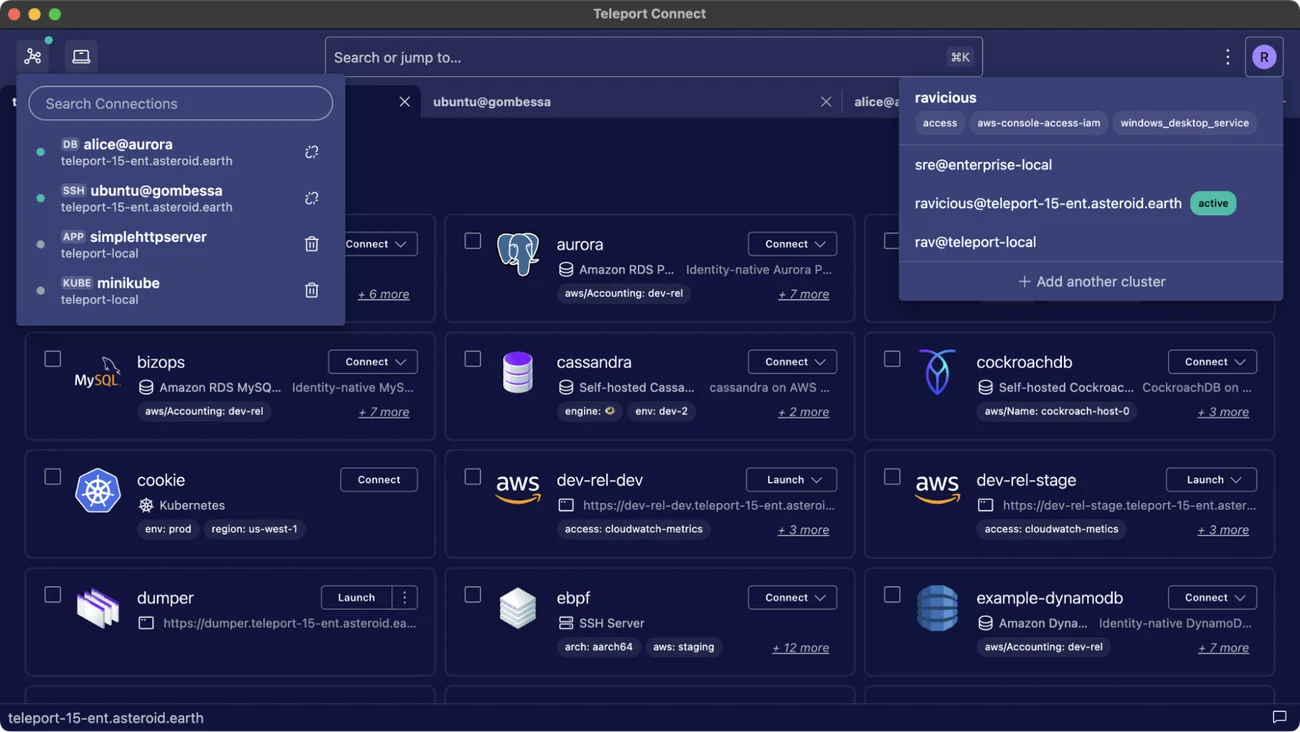
Teleport is an infrastructure identity platform that replaces standing privileges with task-based access controlled by short-lived certificates. Access is granted based on role, device trust, and context, and it expires automatically when the task is complete, so no manual revocation is needed.
Engineers request access through the CLI, web UI, or chat and incident tools, and requests can be approved automatically by policy or require dual authorization for sensitive operations. The same JIT model applies to service accounts, CI/CD pipelines, and automation through Teleport Machine & Workload Identity, with a unified audit trail across SSH, Kubernetes, databases, and cloud access.
Key features include:
- Short-lived, task-based privileges: Replaces standing access with fine-grained privileges issued as short-lived certificates. Access is scoped by role, device, and task context and expires on its own.
- Access requests in familiar tools: Users request access through the CLI or web UI, or through Slack, PagerDuty, Jira, Microsoft Teams, Discord, and Mattermost. Routine role-based access can be granted automatically by policy.
- Dual authorization and session moderation: Sensitive operations can require approval from more than one person, and high-privilege sessions can require an approver to join the session live.
- Access lists: Automates role management and role inheritance, so groups of users receive and lose privileges consistently.
- Machine and workload identity: Replaces long-lived service account credentials with JIT credentials issued per job that expire automatically. Governs GitHub Actions, Terraform, Ansible, and other infrastructure-as-code workflows.
- Temporary contractor access: Grants contractors access with a hard expiry, so it is revoked automatically without manual cleanup.
- Unified session auditing: Records auditable sessions across SSH, Kubernetes, databases, and cloud, with one audit trail for human and machine access.
Limitations (as reported by users on G2):
- Documentation gaps: Documentation can be overwhelming, hard to locate, and short on practical examples for specific use cases.
- Complex self-hosted setup: Self-hosted deployments outside Kubernetes involve many moving parts and can take considerable effort.
- Multi-environment clustering: Building clusters and high availability across different environments, including agent registration, can be difficult.
- Multi-account management: Managing multiple AWS accounts and regions from a single deployment takes extra configuration.
- Learning curve: Initial integration with multiple cloud environments and SSO providers has a learning curve.
Source: Teleport
Vault-Based PAM Platforms
5. Idira Privileged Access Management (formerly CyberArk)

Best for: Large enterprises combining credential vaulting with ZSP
Strengths: Vaulting, ZSP, session isolation, and endpoint controls in one place
Things to consider: Complex architecture, failover, and upgrades when self-hosted
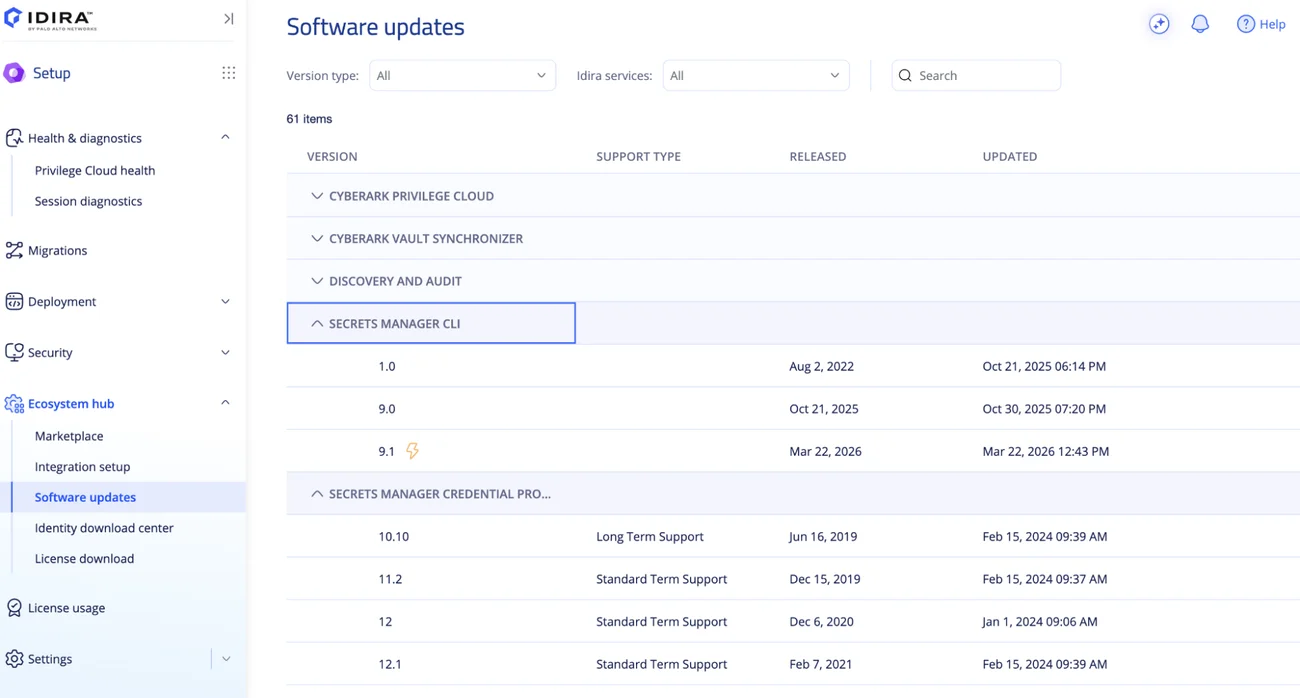
Idira Privileged Access Management is the PAM offering of Idira, the Palo Alto Networks identity security platform built on CyberArk technology. It combines credential vaulting, zero standing privileges, endpoint privilege controls, and session isolation, and covers workforce users, cloud engineers, IT administrators, and third-party vendors.
Under the ZSP model, ephemeral privileges are created when a task starts and destroyed when the work ends, while built-in and system-level accounts stay vaulted and rotated. Idira brokers agentless access to AWS, Azure, Google Cloud, and Kubernetes with JIT entitlements, records privileged sessions, and uses identity threat detection to stop risky sessions.
Key features include:
- Zero standing privileges: Creates context-aware, ephemeral privileges for the duration of a task and destroys them automatically when the work ends, so no dormant credentials remain.
- Agentless cloud and Kubernetes access: Brokers access to AWS, Azure, Google Cloud, and Kubernetes through native CLI and console workflows, with JIT entitlements that replace static, long-lived IAM roles.
- Vaulting and rotation: Stores and automatically rotates credentials for critical system-level accounts, and connects vaulted accounts to JIT workflows for a staged move toward ZSP.
- Endpoint privilege security: Removes standing local administrator rights on Windows, macOS, and Linux and replaces them with policy-based, on-demand application elevation.
- Session isolation and AI summaries: Brokers, isolates, and records privileged sessions across infrastructure and SaaS, with AI-generated summaries that highlight anomalous commands.
- Identity threat detection and response: Analyzes identity signals and can terminate risky sessions or require step-up authentication when it detects lateral movement or vault sweeping.
- Vendor and third-party access: Provides browser-based JIT access for external contractors without VPNs or bastion hosts, with sessions recorded for audit.
Limitations (as reported by users on G2):
- Complex architecture and setup: The architecture requires careful design, and setup and integration with other systems can be time-consuming.
- Redundancy management: Redundant deployments can be hard to manage, and components sometimes need to be brought back up manually after a failure.
- Upgrades and troubleshooting: Upgrades are not always simple, and troubleshooting issues can be complicated.
- Performance: The system can run slowly at times.
- Documentation: Product documentation does not always meet user expectations.
Source: Palo Alto Networks
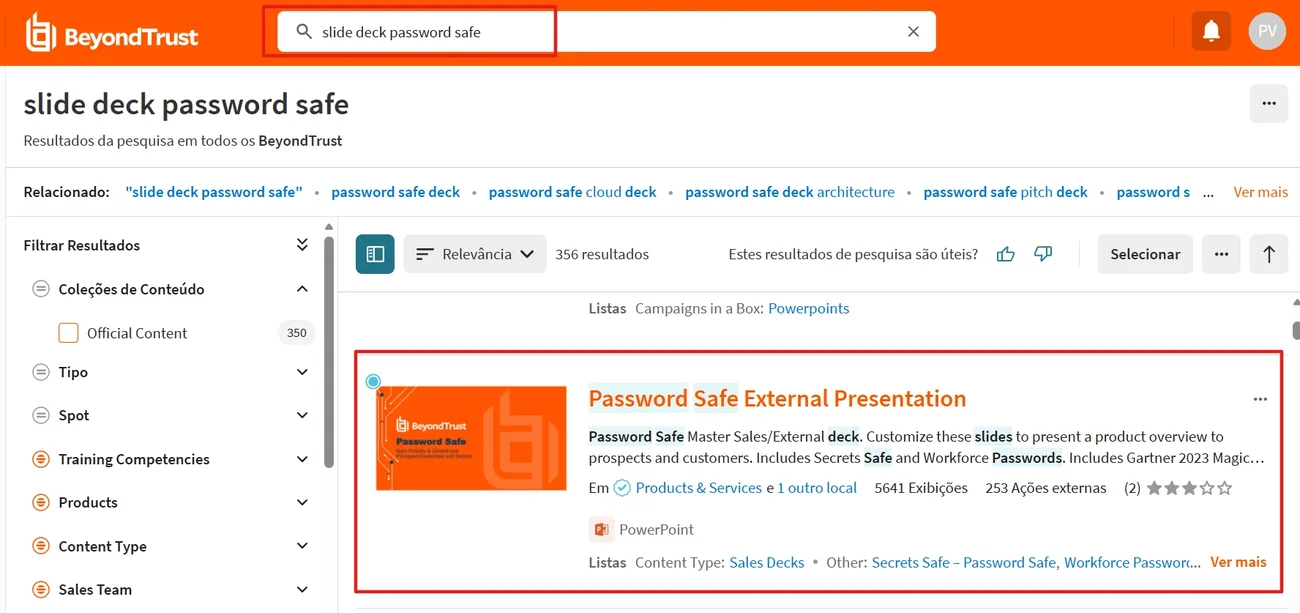
6. BeyondTrust Entitle and Password Safe

Best for: Cloud JIT entitlements plus vault-based on-prem server access
Strengths: Auto-revocation by time, ticket resolution, or on-call rotation
Things to consider: Admin console and bulk actions can be cumbersome
BeyondTrust provides JIT access through two products. Entitle applies just-in-time automation to cloud and SaaS privileges across hundreds of applications, including AWS, Azure, and Google Cloud, with self-service requests that are revoked automatically after a set duration, a ticket resolution, or an on-call rotation.
For on-premises and hybrid servers, Password Safe assigns JIT privileges through its Advanced Workflow Control engine, which evaluates day, time, location, and other context before granting access. Password Safe also brokers RDP and SSH sessions, and its integration with Entitle provides one place to request JIT privileged access.
Key features include:
- Self-service JIT for cloud and SaaS: Users request access through Slack, Microsoft Teams, or Jira, and Entitle revokes it automatically after a set duration, ticket resolution, or on-call rotation.
- Emergency break-glass access: Grants access during incidents using on-call triggers from tools such as PagerDuty and Opsgenie, automated approvals, and JIT provisioning.
- Bundled access requests: Combines multiple roles into a single request, for example SharePoint folders, S3 buckets, and MongoDB tables.
- JIT accounts for non-federated systems: Creates temporary accounts with only the needed permissions, along with SSH keys and secrets, for systems that are not federated.
- Entitlement discovery and access reviews: Discovers entitlements across connected systems, including local accounts, and automates access reviews with a centralized audit trail.
- Context-based access in Password Safe: Evaluates day, date, time, location, and request source before granting access, and can block password access unless a request comes from an approved network.
- Session brokering for servers: Launches RDP and SSH sessions through native tools such as PuTTY and MSTSC, and DirectConnect opens SSH sessions to Unix, Linux, and network devices without installing agents.
- IaC and API support: REST APIs and a Terraform provider support configuration as code.
Limitations (as reported by users on G2):
- Console complexity: The JIT access management console can be complicated for first-time users.
- Bulk administration: Taking action on many objects at once can be time-consuming for administrators.
- Basic search: Search capabilities outside of tickets are limited.
- Cost for smaller teams: Pricing can be high for smaller companies with infrequent access requests.
Source: BeyondTrust
7. Delinea

Best for: JIT and ZSP across servers, databases, Kubernetes, and clouds
Strengths: One policy engine for human, machine, and AI identities
Things to consider: Interface and compliance reporting draw criticism
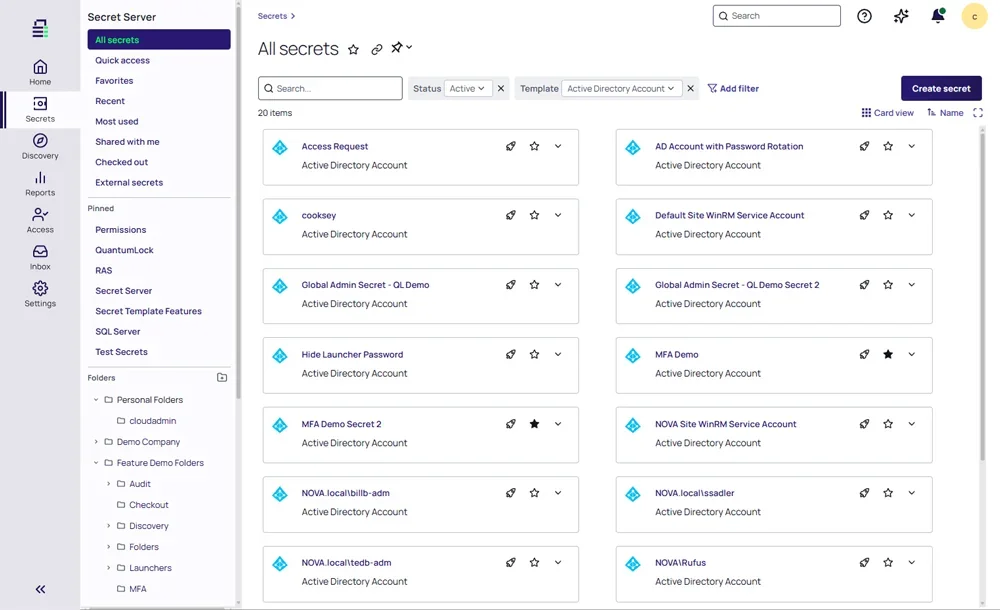
Delinea is an identity security platform that combines credential vaulting, identity governance, and JIT access for human, machine, and AI identities. Its Iris AI engine supports both ephemeral and credential-based access, so organizations can apply zero standing privilege where risk requires it and keep vaulted credentials elsewhere.
Delinea’s policy engine covers servers over SSH and RDP, databases, Kubernetes clusters, AWS, Azure, and Google Cloud consoles, web applications, and AI-driven workflows. Access is granted just in time and revoked when tasks complete, and actions that fall outside policy are blocked in real time.
Key features include:
- Zero standing privilege across infrastructure: Applies ZSP to servers, databases, Kubernetes clusters, cloud consoles, web applications, and AI-driven workflows, with JIT grants revoked when tasks complete.
- Real-time policy enforcement: Extends least-privilege enforcement beyond the initial access request, and blocks actions that fall outside policy as they happen.
- JIT for non-human identities: CI/CD pipelines, GitOps controllers, and automation workflows request JIT access through the same approval processes used for human users.
- Privilege Control for Cloud Entitlements: Provides visibility into entitlements across multi-cloud and on-premises environments, identifies misconfigurations, and automates remediation.
- JIT access for servers: Centrally manages access rights and identity profiles for Windows, Linux, and Unix servers, with fine-grained JIT access, auditing, and session recording.
- Identity consolidation and MFA: Consolidates identities from Active Directory, OpenLDAP, Ping Identity, and Azure AD, and enforces MFA for server access in hybrid cloud environments.
- Endpoint least privilege: Removes local admin rights on workstations, rotates passwords automatically, and controls application access.
Limitations (as reported by users on G2):
- Interface: The interface needs improvement.
- Notifications and reporting: Notifications and reporting related to password compliance are limited.
- Support responsiveness: Customer support could be more responsive.
Source: Delinea
8. Netwrix Privilege Secure

Best for: Windows and Active Directory-centric on-prem environments
Strengths: Ephemeral admin accounts created and removed per session
Things to consider: Licensing cost and troubleshooting effort
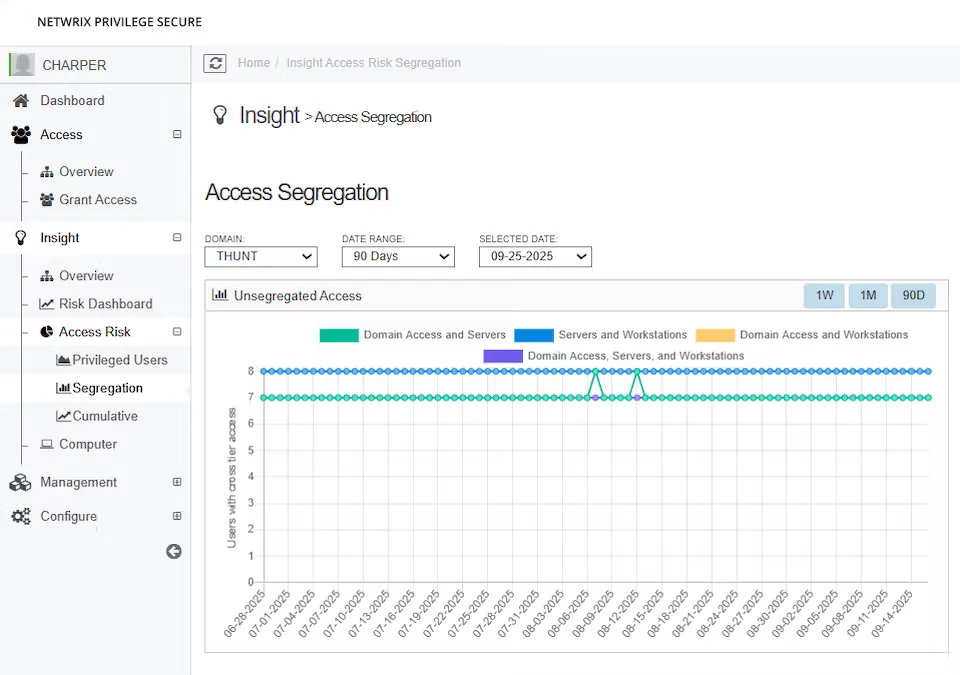
Netwrix Privilege Secure is a PAM solution, formerly known as SBPAM and Remediant, that replaces standing privileged accounts with temporary privileges created only when a request is approved and removed after use. It targets standing domain admin accounts in particular, granting session-based access only when required.
The platform includes agentless discovery of hidden privileged accounts, VPN-free browser-based access with MFA, session monitoring and recording, and automation for high-risk administrative tasks. Endpoint privilege elevation for Windows and macOS is included through Netwrix Endpoint Privilege Manager.
Key features include:
- Zero standing privilege: Creates accounts and access only for approved tasks and erases them after use, removing permanent administrative accounts between sessions.
- Domain admin removal: Replaces standing domain admin accounts with session-based access that is removed once the work is complete.
- Agentless discovery: Scans endpoints without agents to find hidden privileged accounts, and removes standing access with a single click through Privilege Secure for Discovery.
- Secure remote access: Provides VPN-less, browser-based privileged access verified with MFA, fully monitored, and removed automatically when done.
- Session monitoring and audit: Records and monitors privileged sessions with detailed logs for investigations and compliance reporting.
- Privileged task automation: Runs sensitive tasks such as software updates, password resets, and log collection with JIT access for each task, without exposing credentials.
- Endpoint privilege management: Removes local admin rights and grants task-specific permissions on Windows and macOS through Netwrix Endpoint Privilege Manager.
Limitations (as reported by users on GetApp):
- Licensing cost: License costs are higher than some competing products.
- Setup time: Initial setup can take a while.
- Troubleshooting: Troubleshooting documentation does not cover all issues, so many problems require a support ticket.
- Usability of some functions: Some functions could be easier to use.
Source: Netwrix
Conclusion
Implementing Just-in-Time access across hybrid infrastructure is essential for reducing the attack surface by eliminating standing administrative privileges. By automating temporary authorization, organizations can seamlessly secure cloud and on-premises environments without slowing down operational workflows. Establishing centralized time-bound access ensures consistent governance, stronger least-privilege enforcement, and complete audit visibility across complex hybrid estates.